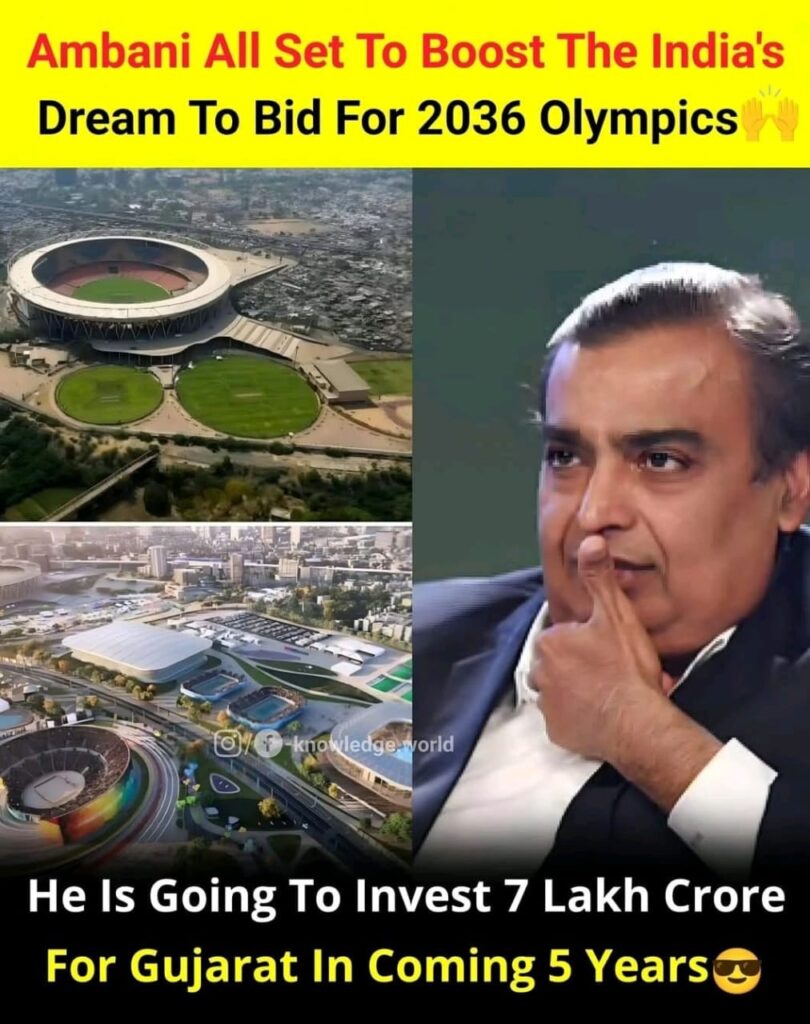
Ambani’s Big Bet on India’s Olympic Dream: A Game-Changer for 2036 and Beyond
India has long held hopes related to the Olympic Games, and those hopes now may finally reach fruition. The image circulating is a powerful tool—a visual representation of Mukesh Ambani’s commitment to solidifying India’s 2036 Olympic bid with a phenomenal investment proposal of ₹7,00,000 crores directed towards Gujarat in the next five years.
This isn’t just another headline. It represents a possible turning point in India’s sporting, economic, and global positioning story.
A Vision Larger Than Sports
Hosting the Olympic Games doesn’t just revolve around Sports; it also involves Building the Infrastructure to host Other Countries to the World. These countries become More than Just Buildings (a stadium and its ancillary) – they become a Legacy.
As large and as populous as it is, India has not hosted the Olympic Games despite its Growth and Development in Economic terms. In recent years, there have been Shifts in the Dialogue of Hosting the Olympics in India due to Infrastructure Deficiencies, Financial Issues, and the Massive Size of Hosting. With the Level of Corporate Financing being discussed, that Narrative is continuing to Change.
Mukesh Ambani’s involvement Clearly Demonstrates the Level of Seriousness. When a Business Leader is known for creating World Class Ecosystems, the Spectator evolves from Aspiration towards Implementation.
Why Gujarat Is at the Center of This Plan
The image highlights Gujarat as the primary focus of this proposed investment—and that choice is strategic, not emotional.
Gujarat has already established itself as one of India’s most business-friendly and infrastructure-ready states. Cities like Ahmedabad have modern transport systems, rapid urban expansion, and experience in hosting large-scale international events. From global summits to massive sports tournaments, the state has proven its capability time and again.
A ₹7 lakh crore investment could mean:
- Olympic-standard stadiums and arenas
- Athlete villages and training academies
- Smart roads, metro expansion, and airport upgrades
- Hospitality infrastructure for international visitors
- Sustainable urban planning with long-term public use
This kind of development doesn’t vanish after the Olympics—it reshapes cities for decades.
Corporate Power Meets National Ambition
One of the biggest hurdles for any Olympic bid is financing. The Olympics are expensive, and many host nations have struggled with post-event debt. What makes this situation different is private-sector leadership complementing government vision.
Mukesh Ambani’s track record shows a pattern: he doesn’t invest for short-term optics. From telecom to retail to green energy, his projects are ecosystem-driven. If such a mindset is applied to sports infrastructure, India could avoid the “white elephant” problem that many Olympic hosts face.
This also sends a strong signal to international bodies like the International Olympic Committee—that India is not just enthusiastic, but structurally and financially prepared.
What This Means for Indian Athletes
Beyond global prestige, the biggest winners could be Indian athletes.
World-class infrastructure at home means:
- Better training facilities without needing to go abroad
- Access to international-level coaching and sports science
- Exposure to global competition standards from a young age
Historically, countries hosting the Olympics often see a significant jump in medal tallies in subsequent years. For India, this could finally translate population potential into podium finishes.
More importantly, it could inspire a sports culture beyond cricket—encouraging athletics, swimming, gymnastics, wrestling, and many other disciplines.
Economic Impact: Jobs, Tourism, and Growth
A ₹7 lakh crore investment isn’t just a number—it’s an economic engine.
Such a large-scale development initiative would generate:
- Millions of direct and indirect jobs
- Growth in construction, real estate, tourism, and services
- Increased foreign investment and global partnerships
- Long-term boost to local businesses and startups
Tourism alone could see a historic surge. Hosting the Olympics puts a country on every global screen, and India’s cultural diversity would become a massive attraction.
Challenges Still Exist—But the Tone Has Changed
Of course, challenges remain. Environmental concerns, land acquisition, urban congestion, and long-term planning will need careful handling. Transparency and sustainability will be critical to ensure public trust.
However, what’s different this time is confidence. The scale of the proposed investment and the stature of the people involved suggest that this is not just political talk—it’s strategic planning.
India is no longer asking, “Can we host the Olympics?”
India is asking, “How do we host them the right way?”
A Defining Moment for India’s Global Image
If this vision becomes reality, the 2036 Olympics could mark a defining chapter in India’s modern history. It would showcase India as a nation capable of executing projects at the highest global standards—efficiently, sustainably, and inclusively.
Mukesh Ambani’s reported commitment adds weight to this dream. Whether as an investor, planner, or catalyst, his involvement could be the difference between a bid and a breakthrough.
For millions of Indians, this isn’t just about sports—it’s about belief. Belief that India is ready to stand shoulder to shoulder with the world’s best, not just in ambition, but in execution.